Showing posts with label toileting needs. Show all posts
Showing posts with label toileting needs. Show all posts
Tuesday, July 29, 2014
Toileting Assistance: 2ND MOST FREQUENT MOVEMENT TASK
In a report sponsored by the National Alliance for Caregiving to identify ways technology can support family members and friends who help sustain elderly, disabled, sick and recovering patients, a panel of national experts and government officials used a "task matrix" to understand the frequency of demand for assistance with movement. HELP TO/FROM THE TOILET was the SECOND MOST FREQUENT TASK, only behind "Help in/out of bed/chair." Perhaps another indication of the need to improve the bedside commode, a common toilet substitute for the mobility impaired?
Catalyzing Technology to Support Family Caregiving, http://www.caregiving.org/wp-content/uploads/2010/01/Catalyzing-Technology-to-Support-Family-Caregiving_FINAL.pdf

Tuesday, July 22, 2014
The way it has been: TIME FOR A CHANGE??
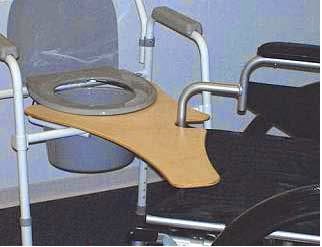
Home medical equipment for many people needing toileting assistance consists of using a transfer board to move from wheelchair and/or bed to a commode and back again. Height cannot be adjusted, and the picture below depicts the design solution for keeping a transfer board from shifting. It does not appear that the average care recipient will be able to position this equipment without assistance from others.  Time for a change?
Saturday, July 19, 2014
Innovating Home Medical Equipment: Who experiences the burden of poor design?
I've been struck by the fact that improving home medical equipment is not as easy as it would seem it should be. Have come to think that this might be partially explained by the fact that the world of HME falls into the domain of low-paid workers and unpaid family/friends, which means the burden of poor design is experienced by those with the functional limitations and their caregivers. Improving the design of HME has not been seen as yielding any value to a hospital or a physician's practice. That means that is it very hard to persuade existing HME companies to take on any risk for introducing such innovations.
Yet, seems like the environment is changing in ways very favorable to getting a toileting improvement to market.
The Accountable Care Act is changing the incentives for providers and health plans. The smart ones will realize that HME is their "last mile" for reaching patients to avoid unnecessary hospitalizations and ED visits, support telemedicine and remote patient monitoring, and keep the mobility challenged with chronic conditions well and at home. Improved HME design will also provide respite to both paid and unpaid caregivers as users are better able to manage their assistive devices for themselves. And there will be plenty of work to go around as we baby boomers age; in fact, we will need this type of self-managed equipment to be able to handle the growing demand for caregiving.
Over the next weeks and months, I'll be posting short reports of our progress. Stay tuned,
Sunday, February 14, 2010
Assistive Toileting: A New Standard of Care?
As my mother aged at home, my family struggled when it came to her toileting care. Like many, the bathroom was too tiny to accommodate her wheelchair, so that solution was out. Nor did the layout of the house lend itself to remodeling; besides, the cost was prohibitive. Upon discharge from a skilled nursing facility, she was given the choices of a patient lift (she was not happy about the prospect of being swung through the air), adult diapers (again, not happy), a bedpan (no one thought that was a good idea) or a transfer board-bedside commode solution. Deciding that the latter preserved most of her personal dignity, she chose the transfer-commode combination. However, we soon came to realize that there were two obstacles preventing her from getting herself on/off the commode: she could NOT (1) manipulate the height of the commode (once set, it remains at the same height); NOR could she (2) anchor the transfer board so it did not shift as she moved along its length. This meant that she still needed assistance when she needed "to go."
That lack of full independence meant that my sisters and I had to be responsive to her "on-demand" toileting needs, a source of frustration in an otherwise very loving and supportive family environment. When she passed away, we thought, "Why wasn't the commode more manageable for her to get on/off by herself?" Drawing upon our experiences helping her, we came up with functional solutions to her commode height-transfer challenges.
Naively, we thought that Home Medical Equipment (HME) companies would be interested in solving a problem experienced by many care recipients and their caregivers, particularly if the solutions were patented (U.S. patent #7,562,400).
However, we soon came to understand that, despite all the talk about the importance of entrepreneurs and innovation, it is VERY hard to bring new products to market, especially in healthcare. Companies want to see "proof" that there is a market. That's where advances in social media, such as this blog, may prove to be instrumental in launching functional improvements in home medical equipment.
That lack of full independence meant that my sisters and I had to be responsive to her "on-demand" toileting needs, a source of frustration in an otherwise very loving and supportive family environment. When she passed away, we thought, "Why wasn't the commode more manageable for her to get on/off by herself?" Drawing upon our experiences helping her, we came up with functional solutions to her commode height-transfer challenges.
Naively, we thought that Home Medical Equipment (HME) companies would be interested in solving a problem experienced by many care recipients and their caregivers, particularly if the solutions were patented (U.S. patent #7,562,400).
However, we soon came to understand that, despite all the talk about the importance of entrepreneurs and innovation, it is VERY hard to bring new products to market, especially in healthcare. Companies want to see "proof" that there is a market. That's where advances in social media, such as this blog, may prove to be instrumental in launching functional improvements in home medical equipment.
Subscribe to:
Posts (Atom)
